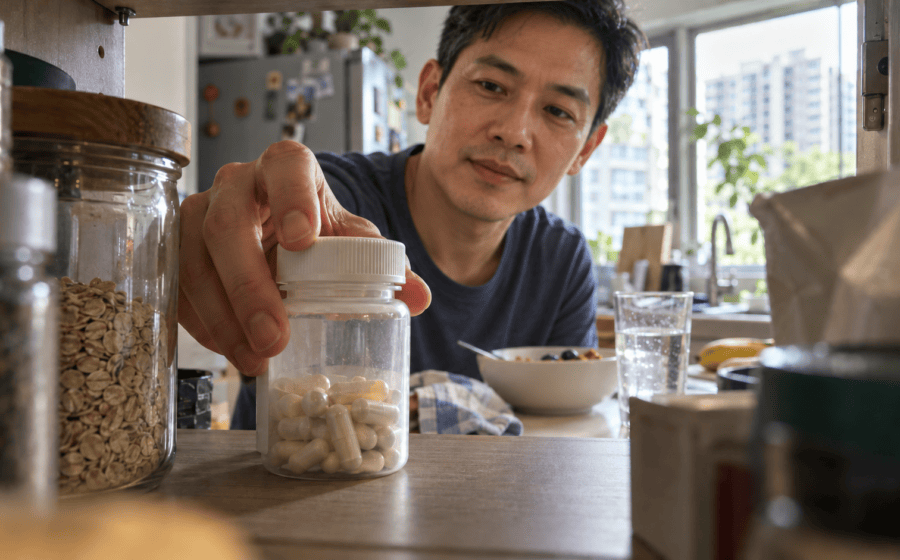

Can children’s cognitive performance be tracked in everyday life, without bringing them into a testing centre for every assessment? In Singapore, the SYRES team coordinated a home-based study for Activ’Inside that combined digital cognitive tasks, parents’ observations and medical supervision. Among the 41 children included in the analysis, the global cognitive score was 17.1% higher at Day 28 than at baseline. The finding is worth exploring, with one essential qualification: the study did not include a control group.
Looking at test performance and everyday behaviour
Activ’Inside wanted to explore changes in cognitive performance among children taking 150 mg of Memophenol™ daily. Memophenol™ is a polyphenol-rich grape and blueberry extract. The study was designed to capture two complementary perspectives: how children performed on cognitive tasks and what their parents observed in daily life.
Our Singapore team recruited families from the SYRES panel, organised the home-based schedule and coordinated the assessments under medical supervision. The study ran from 6 July to 2 August 2025 with healthy children aged 7 to 12. Fifty-two children were enrolled, and 41 completed the study according to protocol and were included in the analysis. The final group comprised 21 girls and 20 boys, with an average age of 9.5 years. Eleven enrolled participants were excluded from the analysis because they did not comply with study instructions.
The study at a glance
| Element | Approach |
|---|---|
| Daily use | One red-berry-flavoured powder stick containing 150 mg of Memophenol™, dissolved in water and consumed with breakfast for 28 days |
| Children’s assessments | Six CogniFit Kids mini-games completed at home under a parent’s supervision, in sessions lasting approximately 15 to 20 minutes |
| Assessment points | Before the first intake (Day 0), two hours afterwards, then on Days 14 and 28 |
| Parents’ assessments | BRIEF-2 questionnaire on Days 0, 14 and 28; satisfaction questionnaire on Day 28 |
| Tolerability | Collection of any adverse events under medical supervision |
CogniFit Kids provided an overall score and scores for domains including memory, attention, reasoning, perception and coordination. Parents completed the BRIEF-2 to describe their child’s executive functioning in everyday situations, including behavioural and emotional regulation. The two measures run in different directions: on the BRIEF-2, a lower score indicates fewer difficulties reported by parents.
Cognitive scores rose across the assessment period
Compared with the assessment completed before the first intake, the CogniFit global cognitive score was higher at each subsequent time point:
- +9.5% two hours after the first intake
- +13.9% on Day 14
- +17.1% on Day 28
All three differences were statistically significant in the published analysis (p < 0.001). At Day 28, the domain scores had also increased:
- Perception: +29.8%
- Memory: +22.9%
- Reasoning: +14.5%
- Attention: +9.1%
- Coordination: +6.3%
These are changes in performance on digital cognitive tasks. They do not represent measured improvements in IQ or school grades.
What parents noticed
The BRIEF-2 results moved in the same general direction. Its Global Executive Composite score fell by 8.3% on Day 14 and 12.9% on Day 28 compared with baseline (p < 0.001). At Day 28, its three indices had decreased by:
- 11.5% for behavioural regulation
- 14.4% for emotional regulation
- 12.8% for cognitive regulation
The final questionnaire captured families’ own impressions:
- 63% of parents reported a noticeable improvement in their child’s attention
- 66% considered the product effective overall
- 61% said they intended to continue using or purchase it
These responses add a view of daily experience, but they are parents’ reported perceptions. The parents knew which product their children were taking.
Adherence and tolerability over 28 days
Among the children analysed, 80.5% did not miss a dose during the 28-day period; the others missed one or two. One mild, short-lived gastrointestinal event was reported on the first day. It resolved without treatment or discontinuation. The publication reports 97.6% tolerability within this sample. The study’s size and duration do not establish the product’s safety for all children or over longer periods.
Useful real-world observations, with clear limits
This project illustrates the value of combining children’s digital tasks, parents’ observations and adherence monitoring in a home-based study. Repeated assessments captured different aspects of the experience over four weeks, rather than relying on a single end-of-study questionnaire.
The findings remain exploratory. This was an open-label study with no placebo or control group. Familiarity with the mini-games may have helped children improve their scores, while parents’ expectations may have influenced their responses. The observed changes therefore cannot be attributed with certainty to Memophenol™. A randomised, double-blind, placebo-controlled study in children would be needed to confirm an effect and establish its size.
For SYRES Singapore, the study shows how targeted recruitment, family coordination, repeated assessments and medical supervision can be brought together in a real-world research protocol, while keeping the interpretation of its results precise.
Source and disclosure. Gille I. et al., “Evaluation of Acute and Sustained Cognitive Effects of a Grape and Blueberry Polyphenol-Rich Extract in Healthy 7-12 Years Old Children: A Home-Based, Real-World Consumer Study”, Journal of Nutrition & Health, published 14 March 2026. Read the published paper. Activ’Inside funded the study and supplied the study product. All authors of the paper are Activ’Inside employees. The publication acknowledges the SYRES team for clinical supervision and study coordination.
Keep reading